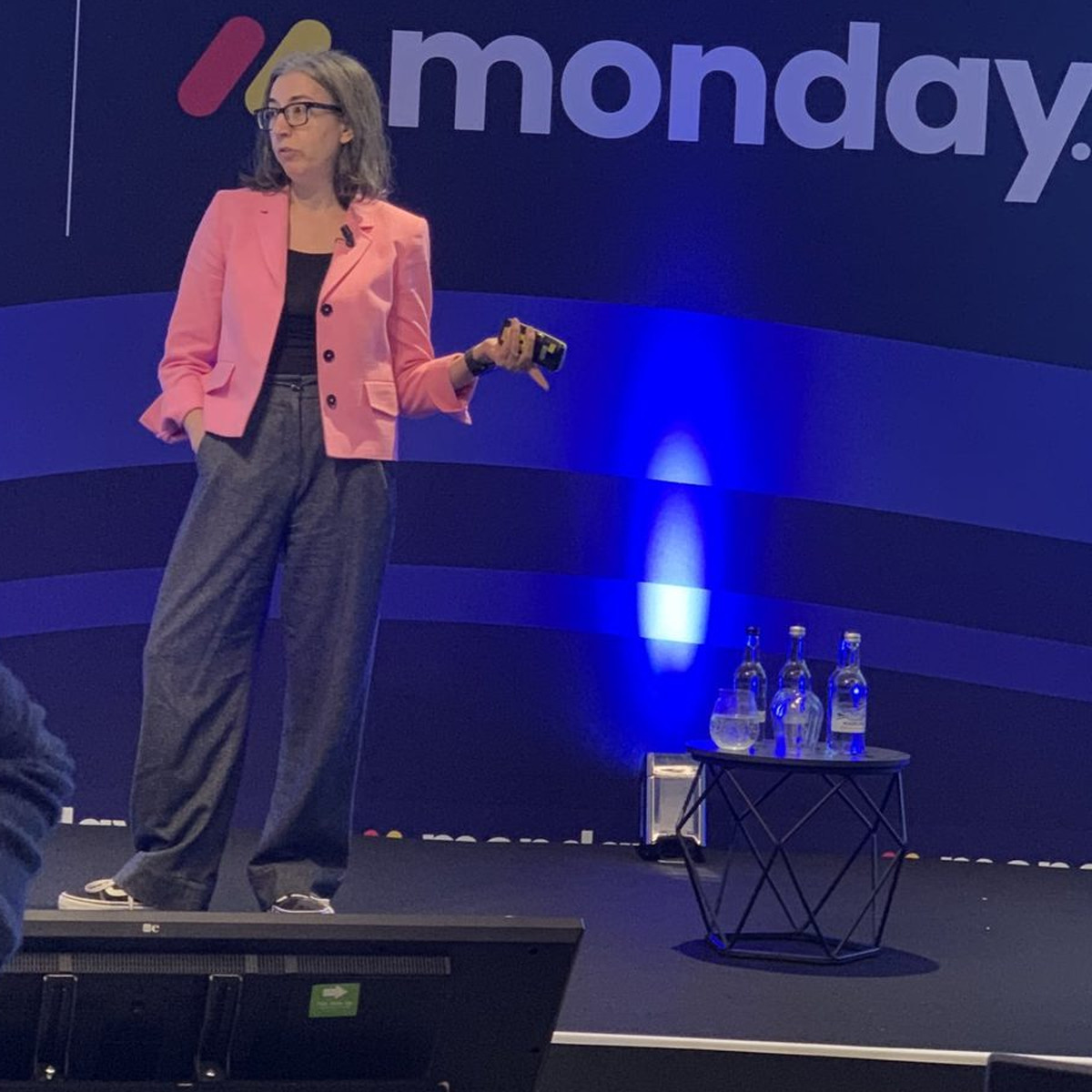
Beth Ayers opened her talk with a confession on the big screen.
"I am lazy. I'm disorganised, I hate file systems, and I've never been able to structure things in a way that works for me."
This from the CEO of Metomic, a data security company. At an AI conference. In front of a room full of people who'd come to hear how to be more productive.
Of all the sessions at aiblLIVE in London on 20 October, hers is the one I keep coming back to.
A brain made of files
Beth's problem will be familiar to anyone who uses AI tools every day. Every new chat starts from nothing. You explain who you are, how you write, what the project is, and what you did last time. And you do it all again tomorrow.
So she moved her work into Claude Code, using the desktop app. Nothing that looks like programming. "I'm not a coder," she said. And then she did the clever, lazy thing.
"The idea of building a file structure for Claude petrified me," she said. "So instead I've had Claude build its own file structure, and I never have to worry about it."
Her one-line summary of the whole system was on a slide: "The model thinks. My files remember."
The AI is brilliant but forgets everything. Files remember everything but can't think. Put them together and you get something closer to a brain.
What's inside
Every time she opens a new window, the AI reads a short rules file, an index of what it knows and a list of specialists. She has around sixteen of them, each with a job: one writes in her voice, one in the company's voice, others cover security, sales follow-up and finance. Some are agents. Some, as she put it, "are just markdown files that know more than other markdown files." She doesn't care which, because they all behave the same.
There's also what she called the work ledger. One line per session: the day, what was produced, where it lives. "I got annoyed at Claude redoing work," her slide said. "I asked why, and how we fix it. This was Claude's answer."
So a board pack started on a Wednesday can be picked up in a fresh window days later, without hunting for the old chat.
Why this is my next step
Here's my honest take. I use AI a lot in my work. I write with it, plan with it and test ideas with it. But like most people, I still mostly use it one chat at a time.
Beth showed what the next level looks like. It's a middle layer between me and the model: my rules, my voice, my notes and my history. All of it sits in files the AI can read and keep up to date itself.
That's what I need to start doing. Getting stuck into tools like Claude Code and Codex, and building that middle layer for myself. Most people are still using AI the same way everyone else does, and that's exactly the reason to do it differently. It's how you get further ahead, and stay ahead.
So I'm going to build it. Done beats perfect, after all: a rough version that works today is worth more than a perfect one I never start. If I can make it work as a busy marketer who isn't a developer, so can plenty of the business owners and coaches I work with.
Picture opening your laptop on a Monday and your AI already knows your voice, your clients, your priorities and what you finished on Friday. No re-explaining. No starting from scratch.
That's what Beth already has. The time you save is nice. The bigger win is that the AI gets better at being yours every single week.
You don't need to build the whole thing to start. A single page called "about me" would do: how you write, who you work with and what you care about. Paste it in at the start of your next few chats and see what changes. That page could be the first file in your own brain.