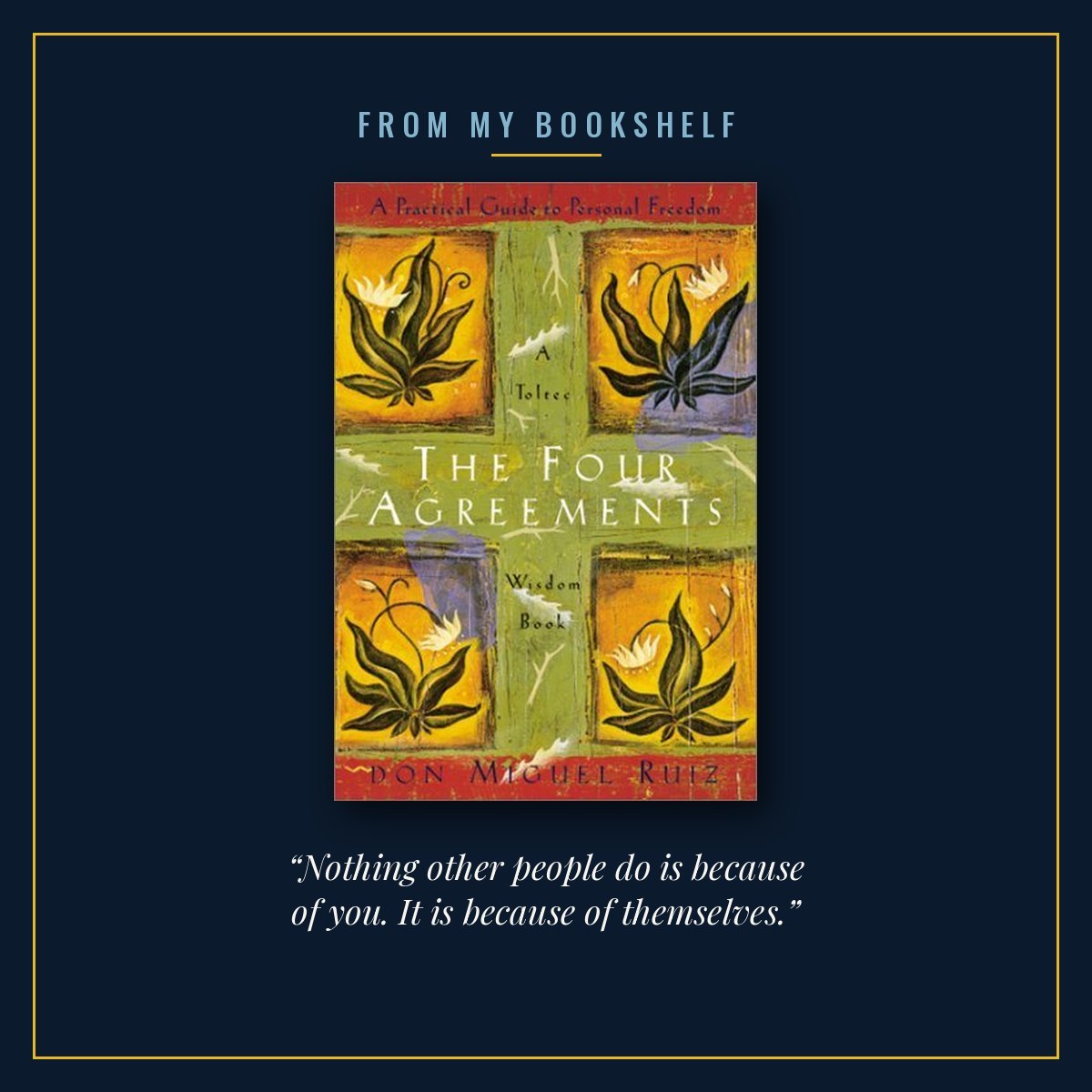
Seven. That’s how many times my Goodreads account says I’ve read The Four Agreements by Don Miguel Ruiz. It’s one of the few books I go back to just about every year, and it’s a small one. You could finish it in an afternoon.
I adore it. The best way I know to explain why is to tell you the four agreements, because they’re the whole book in four short lines.
Be impeccable with your word. Don’t take anything personally. Don’t make assumptions. Always do your best.
Ruiz draws on old Toltec wisdom from Mexico. He calls them agreements because they’re promises you make with yourself. Nobody else has to sign anything. They sound simple, and they are. Living them is the hard bit.
Ruiz’s starting point is that we’ve all been signed up to a whole bunch of agreements we never chose. As kids we’re taught what’s good, what’s bad, who we’re supposed to be. He calls it domestication. A lot of those old agreements are about fear and not being good enough. The four in the book are there to replace them.
The one that keeps coming up
The second agreement is the one that turns up most in my conversations. Ruiz puts it like this: “Nothing other people do is because of you. It is because of themselves.”
Someone’s short with you. Someone ignores your message. You build a whole story about what you did wrong. Most of the time it has nothing to do with you. They’re carrying their own stuff, and you just happened to be standing there.
When you stop taking everyone’s response to you personally, life gets easier. It really is that simple.
Nigel Risner and I co-hosted a podcast together for more than five years, and we both rate this book. Nigel’s twist is that it includes praise. Don’t take the good feedback personally either. He told a story on the show about a big conference where 900 people said he was the best speaker they’d ever heard. His ego got even bigger than normal. He never heard from that company again.
I love that, because most of us only use it one way. We try to shrug off the criticism and then lap up the compliments. Both are other people’s stories about you.
Nigel adds a fifth agreement of his own: TTTTF. Tell the total truth faster. And his rule for reviews is a good one. Throw out the top two who want to marry you and the bottom two who want to kill you. Look at the 96 in the middle.
Nigel once opened an episode with a line he’d got from the book: what other people think of you is none of your business. I added the flip side. What you think of other people is none of theirs, and you don’t have to tell them.
Then there’s assumptions. Think how many things have been harder than they needed to be because of an assumption you got wrong. The message you read in the wrong tone. The silence you decided meant no. Ruiz’s fix is almost boring. Ask. Find the courage to ask the question and say what you actually want.
Being impeccable with your word starts closer to home than you’d think. Ruiz is clear that it includes the way you talk about yourself. The voice in your own head counts. If you wouldn’t say it to a friend, why are you saying it to you?
And always do your best. This is the one people misread as pressure. It’s the opposite. Ruiz says your best changes from moment to moment. Your best when you’re tired or ill looks different from your best on a good day. You can never do better than your best, but your best tomorrow might be better than today’s.
That fourth agreement sits right next to the idea behind my own book, Done Beats Perfect. In plain words: finishing something good beats endlessly polishing something that never sees daylight. Do your best with what you’ve got today. When you learn better, you can do better.
Four really simple agreements to make with yourself. And boy, do they make a difference. That’s exactly why I keep picking it back up.
Ruiz wrote a follow-up, The Mastery of Love, and I used a line from it on my 2016 advent calendar. I believe everything we do is driven by one of two things, love or fear. When we come from fear, we make bad decisions and life gets harder than it needs to be. The four agreements are a pretty good map for coming from the other place.
It’s in my free guide, 50 Books That Shaped Me, alongside the other books that helped me go a bit easier on myself.
Which of the four would you find hardest to keep?