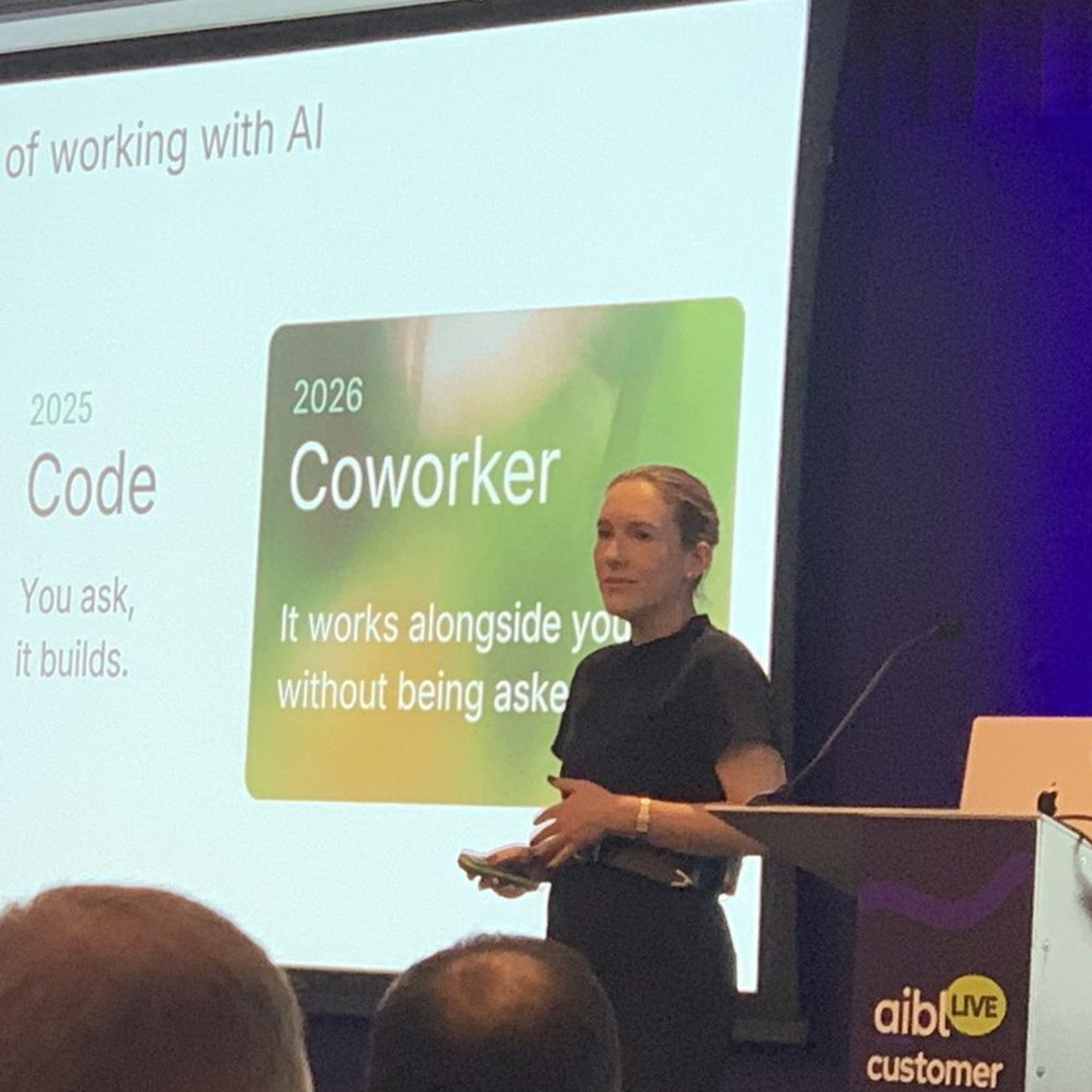
Rebecca Okin asked the room to think of someone before she showed a single demo.
"Who is the best coworker you know, and what are some of their qualities?"
She answered for us. "They're proactive. They don't need to be asked to do the good things. They bring not just problems, but solutions."
I'd guess most people in the room pictured someone straight away. The colleague who spots the problem before it lands on your desk. Who sends you the fix along with the bad news. Who knows when to interrupt you and, just as important, when not to.
Rebecca is a Solutions Engineer at Sierra, which builds AI customer service agents. Her talk at aiblLIVE in London on 20 October was about building an AI that behaves like that colleague.
From tool to teammate
She described three stages. In 2022, AI was chat: you ask, it answers. By 2025, it was code: you ask, it builds. Now, in 2026, she argued it's becoming a coworker. It works alongside you, without being asked.
Sierra's version is called Ghostwriter. It helps their customers improve the AI agents that talk to their own customers. The new version lives in Slack or Microsoft Teams, where the humans already are.
The detail I liked most was this. Ghostwriter "stays quiet 90% of the time, even though it's constantly scanning for things happening."
The examples that sold it
Rebecca shared real examples, with the names taken out.
One customer's traffic doubled overnight. Ghostwriter worked out that a new fee notice had gone out that its agent knew nothing about. Instead of making up a policy, it asked who owned it.
In another, it noticed a handful of chats out of 175 were mishandling a delivery status. It raised it. A few days later, it came back to its own thread with a single question: "Should we reopen it?"
And at one company, it started running weekly tests on the customer agent and posting the results every Monday morning. "Nobody asked for this," Rebecca said. "This was Ghostwriter's idea."
It also takes feedback. Tell it you're the wrong person to approve something and it goes to the right one. It learned to post at 9am for a team in New York, and to judge whether something could wait until after a Friday night.
"That's how we brought it from a tool to a teammate," she said.
What this means for a small team
Most small businesses won't build anything like Ghostwriter. But the idea behind it is useful right now.
Right now, most of us use AI the way we'd use a search box. You ask, it answers, it waits for the next question. The shift Rebecca described is towards AI that watches something for you and only speaks up when it matters. Overdue invoices. A drop in enquiries. A customer who hasn't been back in three months. A run of unhappy reviews.
Those are exactly the jobs that slip in a busy small business. Nobody owns them. As Rebecca put it, "these are not things that are one person's defined job."
Think about having someone on the team whose whole job is to notice. It doesn't nag. It doesn't fill your inbox. It taps you on the shoulder twice a week with something that really needed your attention, and a suggested fix.
The result is fewer things falling through the cracks, and more of your own attention left for the work only you can do.
If you want to start small, think of one thing you wish someone would keep an eye on. Put it as a rule: "Tell me when this happens, and suggest what to do." A simple automation, a scheduled AI check or even a weekly calendar reminder could handle it. What would your one thing be?